

Point-of-Care Systems: Can Diagnostics Go Where Disease Starts?
As a legacy of the Covid pandemic, Point-of-Care (POC) systems are a fast and flexible solution to prevent pandemic outbreaks.
The Covid pandemic taught us a lot. We saw infections increase rapidly, day by day, hour by hour, sometimes minute by minute. What if health personnel – even outside the health system – had had a fast and reliable POC system to diagnose disease agents?
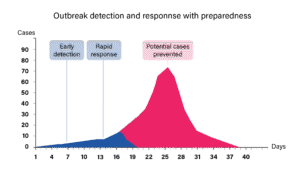
An epidemic in a population will always develop slowly in the beginning. As contacts between infected and healthy individuals increase, more and more people will become infected until the number of cases suddenly increases exponentially. This provides us with a window of 1-2 weeks to react before the epidemic gets out of hand.
This makes early detection crucial for a rapid and targeted response to prevent many potential cases and thus curb the exponential epidemic curve (see illustration below).
POC systems are fast and portable diagnostic tools that can detect disease agents directly on site, without the need to send samples to a central laboratory. They are easy to use, don’t require specialised equipment or trained personnel, and provide results in less than 30 minutes.
This makes them extremely valuable for delivering timely information to health professionals and authorities, enabling quicker responses to limit the spread of disease.
One of the main advantages of POC systems is their flexibility: they can be used directly in the field, even in settings outside the formal healthcare system, such as in farm animal populations or among wild migratory birds, where many epidemics can originate. During animal disease outbreaks, POC testing also helps reduce the burden on central labs and speeds up the lifting of restriction zones and movement bans, supporting a quicker return to normal operations.
Integrating POC testing into disease surveillance strategies can significantly enhance our ability to detect and contain outbreaks at their source. And this is precisely why we at the PAIR project are developing such POC systems.
With the contribution of Mogens Madsen (UCPH)
Photo by Ashkan Forouzani on Unsplash
